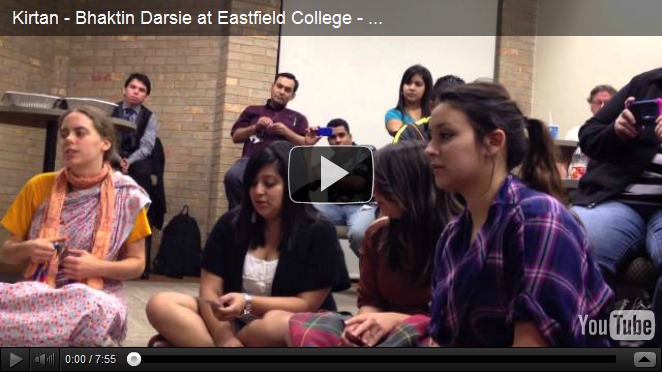
We were invite to a philosophy class at Eastfield to discuss the concise Vedic philosophy. The program ended with a kirtan lead by Bhaktin Darsie and a wonderful feast cooked by Narottamānanda Prabhu.
We were invite to a philosophy class at Eastfield to discuss the concise Vedic philosophy. The program ended with a kirtan lead by Bhaktin Darsie and a wonderful feast cooked by Narottamānanda Prabhu.

Book distribution to happy recipients. Distributing Santas' gifts "The devotees of the Supreme Lord, or the persons who are in Kṛṣṇa consciousness, are called santas, and they are always in love with the Lord"-purport to Bhagavad Gita 3.13


Each week we will post a question to a panel of about two dozen clergy, laity and theologians, all of whom are based in Texas or are from Texas. They will chime in with their responses to the question of the week. And you, readers, will be able to respond to their answers through the comment box.
The slayings today at a Connecticut school obviously present a horribly grim situation. So, drawing upon your faith traditions, how would you try to comfort a family caught up in such an awful scenario?
NITYANANDA CHANDRA DAS, minister of ISKCON (International Society for Krishna Consciousness), Dallas
We share your grief. My wife spent the entire night, off and on, crying. The Bhagavad Gita explains that we can mourn our separation from that person but we should understand that the self is not subject to death.
Bg 2.13 — As the embodied soul continuously passes, in this body, from boyhood to youth to old age, the soul similarly passes into another body at death. A sober person is not bewildered by such a change.
Bg 2.17 — That which pervades the entire body, you should know to be indestructible. No one is able to destroy that imperishable soul.
Bg 2.20 — For the soul there is neither birth nor death at any time. He has not come into being, does not come into being, and will not come into being. He is unborn, eternal, ever-existing and primeval. He is not slain when the body is slain.
Bg 2.22 — As a person puts on new garments, giving up old ones, the soul similarly accepts new material bodies, giving up the old and useless ones.
Bg 2.23 — The soul can never be cut to pieces by any weapon, nor burned by fire, nor moistened by water, nor withered by the wind.
Bg 2.24 — This individual soul is unbreakable and insoluble, and can be neither burned nor dried. He is everlasting, present everywhere, unchangeable, immovable and eternally the same.
Bg 2.25 — It is said that the soul is invisible, inconceivable and immutable. Knowing this, you should not grieve for the body.
Each week we will post a question to a panel of about two dozen clergy, laity and theologians, all of whom are based in Texas or are from Texas. They will chime in with their responses to the question of the week. And you, readers, will be able to respond to their answers through the comment box.
Rabbi Michael Lerner wrote last week about Chanukah, describing it as “the holiday celebrating the triumph of hope over fear, light over darkness, the powerless over the powerful.”
He went on to say that Chanukah is about “understanding that when we connect with the transformative power of the universe, the Force of Healing and Transformation, YHVH, we become aware that the powerless can become powerful, that oppression of any sort is in contradiction to the fundamental nature of human beings as loving, kind, generous, free, creative, intelligent, attuned to beauty, caring for and needing each other beings created in the image of God. When that energy and awareness permeates our consciousness, no ruling elite and no system of exploitation can possibly last for very long.”
Of course, this also is the month when Christians will hear much about bringing joy to the world, peace on earth and goodwill to all.
But is that so? Is it really possible to heal the world?
Some whose theology predicts an end-times see the world as marching from bad to worse, with God intervening at the end. Others hold to a theology that sees them as being used by God to bring his kingdom on earth as it is in heaven. Still others are neither so fatalistic nor optimistic.
Where do you stand? What does your faith tradition say about healing the world?
NITYANANDA CHANDRA DAS, minister of ISKCON (International Society for Krishna Consciousness), Dallas
This temporary material world serves as an impetus for us souls to give up a false lordship over the temporary. Actually we are not our bodies, we are not black, white, Republican, Democrat, and so on. We are an eternal spirit soul inhabiting a temporary vehicle. This vehicle has four major problems that everyone overlooks: old age, disease, death and then birth again.
In our factual existence there is no death or old age. Therefore, to really have a heavenly life means to have a life free from death. Just as one cannot truly enjoy a meal that you know would be your last, so similarly no soul will find satisfaction in the temporary. 
However, those who are in constant contact with the Supreme find ever new bliss and satisfaction in that relationship. Such bliss in relation to the eternal is ever increasing and can be experienced in this world.
As time goes on, social culture decreases and materialism will increase. That is called Kali Yuga, but this also creates a clearer view that the temporary cannot satisfy.
So as things get worse, a few intelligent or fortunate souls can see the futility of material advancement and thus take shelter of the eternal. Those who take shelter of God will find their hearts gradually become godly and thus they can experience heaven even in hell, what to speak of Earth.
The greatest charity one can do is learning how to love God and teaching others to do so. In this way, one can create a golden age.
Each week we will post a question to a panel of about two dozen clergy, laity and theologians, all of whom are based in Texas or are from Texas. They will chime in with their responses to the question of the week. And you, readers, will be able to respond to their answers through the comment box.
We are only two days away from Thanksgiving, when many of us will join others for a wonderful meal around a table. Presumably, many will say thanks and offer a prayer.
The writer Anne Lamott offered her observations about saying grace in this Parade article. The piece is based upon her new book, Help, Thanks, Wow: The Three Essential Prayers.
Here’s one quote from her Parade essay that struck me as realistic and pertinent:
“We’ve all been held hostage by grace sayers who use the opportunity to work the room, like the Church Lady. But more often, people simply say thank you — we understand how far short we must fall, how selfish we can be, how-self-righteous, what brats. And yet God has given us this marvelous meal.”
She has her take on saying thanks, which I rather like. But why do we say grace over a meal, including a traditional one like the Thanksgiving dinner?
NITYANANDA CHANDRA DAS, minister of ISKCON (International Society for Krishna Consciousness), Dallas
What I practice is often called the kitchen religion. For example, last Sunday our temple held a festival wherein we had a 1000+ preparation feast. Sacred food is part of our every day life, for spirituality should not be a once a week event but rather 24/7.
How can we do this practically? Everyone has to eat, and food is produced by the mercy of God. We cannot eat nuts and bolts from factories. So out of respect, food should be first cooked and offered to God. This offering is not simply an affair of respect. Cooking for someone is a natural way to express love. So in the intermediate stages such an offering may be out of respect, but in the advanced stage it is out of love.
Love means that acts are done selflessly for the other person's benefit. Sacred literature proclaims that one can offer pure foods - vegetarian food - to God and He will accept if it cooked and offered with love. That is what called a karma free diet: no one is harmed, and even the soul in the vegetables that are offered are benefited. Such food is called prasadam.
One is example is that of a wife who eagerly awaits for her husband to return from war. On the day of his return, she goes to the grocery store buying ingredients for the food that she thinks that he would like. She then cooks that food and lovingly serves him when arrives at home. So her shopping and cooking and serving are all being done with the meditation pleasing her husband. So similarly one can shop, cook and offer food to God with loving feelings. Therefore not only moment of saying grace is sacred but the entire endeavor down to the trip to the grocery store becomes a spiritual meditation. By offering vegetarian food not only is the turkey thankful but even God Himself is pleased to see that we are following His commandment of Thou shalt not kill.
Each week we will post a question to a panel of about two dozen clergy, laity and theologians, all of whom are based in Texas or are from Texas. They will chime in with their responses to the question of the week. And you, readers, will be able to respond to their answers through the comment box.
By the time this answer gets posted, Election Day will have arrived. The presidential campaigns will have made their closing arguments. Supporters will have advocated for their candidate. And, if polls are any guide, Americans will be pretty evenly divided.
So, barring another Florida, America will wake up Wednesday with one side joyously happy and another bitterly disappointed. Or, that’s how core supporters of Barack Obama and Mitt Romney will feel. The losing side will be tempted to demonize those who voted for the winner. And the winner’s supporters will be tempted to gloat about the victory.
Neither response will help the country move forward as one. Neither response will help us move beyond the politics of division. And neither will help us realize that we really function best as a country when we balance individuality with community.
With that in mind, here’s the question for this week:
“What is the message that different faith traditions can send about the importance of being one?”
NITYANANDA CHANDRA DAS, minister of ISKCON (International Society for Krishna Consciousness), Dallas


In a Krishna Conscious, or God Conscious, society, individuals have the mutual goal of giving pleasure to the Supreme Father. The ripples caused by stones thrown in a pool at one point do not interfere with other ripples. Rather, they create strength.
Similarly, the God Conscious help each other rather than compete. A true leader protects all prajas (those born in his kingdom) - not just the Caucasians or African Americans, but all creatures - from injustice. Thus there is the most often ignored commandment, thou shalt not kill.
In regard to oneness, advaita, in theism the Vedas exclaim unity in diversity. Hence the oneness of God must not overshadow His diversity. God is in everything but God is not so impotent that He loses His own individual existence. Just as the sunlight spreads everywhere but the Sun planet continues to exist.
Each week we will post a question to a panel of about two dozen clergy, laity and theologians, all of whom are based in Texas or are from Texas. They will chime in with their responses to the question of the week. And you, readers, will be able to respond to their answers through the comment box.
“I have spent the last several days in Colorado, interviewing voters in that very swing state. If predictions hold up, we are down to only a handful of states that matter now to each campaign.
Last week, both Mitt Romney and Barack Obama campaigned in Denver. Romney drew 10,000 people at Red Rocks Amphitheater. Obama drew 16,000 in City Park.
By all reports, the crowds were enthusiastic. If you like politics, this is when campaigns turn fun and bubble over with energy.
But as this campaign draws to an end after more than a year of rallies, debates, speeches, ads and strategy sessions, I have also been thinking of something else:
Do we thirst too much for a leader?
I love our democracy as much as the next person. And I really like the thrill of a campaign. But it has been 10 months and many dollars since New
Hampshire and we still haven’t selected the next president. At moments during this marathon, it has felt like we spend too much time and energy searching for a leader, almost like a people who want a king to come fix their problems for them.What do you think? Is this just democracy-in-action? Or are we too hungry for a leader?”
NITYANANDA CHANDRA DAS, minister of ISKCON (International Society for Krishna Consciousness), Dallas
I do not have much faith in our democracy. We do not know what is an ideal leader, so our enthusiasm is misplaced. One proper leader is far better than hundreds of ministerial puppets put into a position in an X Factor-like fashion. A proper leader is toned by training and responsibility, rather being swayed to win the popularity contest.
The working class are like the legs of the social body, the business class the stomach, the political leaders the arms which protect. The best political systems are when the leader takes guidance from morally upstanding spiritual philosophers who are unconcerned with financial gain. Such philosophers are the head of the social body.


