Tuesday, January 22, 2013


Tuesday, January 15, 2013
TEXAS FAITH 91: How do we create the common good in Texas?

Dallas Morning News,
Each week we will post a question to a panel of about two dozen clergy, laity and theologians, all of whom are based in Texas or are from Texas. They will chime in with their responses to the question of the week. And you, readers, will be able to respond to their answers through the comment box.
We spent a good deal of time last year on this blog and in public meetings discussing the common good. We talked about defining the common good in Dallas. We talked about the presidential election and the common good. We talked about government and the common good. But we didn’t talk about Texas and the common good.
So, as we start 2013, and the Texas Legislature begins its every-other-year session, let’s discuss that topic.
More specifically: How do you think the state can create a greater sense of the common good?
For some, this will mean greater attention to poverty issues or those left behind. Texas often ranks high among states when it comes to providing various social services, such as mental health care. And high doesn’t mean good. It means we rank 45th, 46th, 47th, etc. in a comparison of states when it comes to spending for a social service.
At the same time, Texas’ economy is in a better place than that of most states. A recent survey of CEOs ranked Texas as the best place to do business. The result of the business-friendly attitude for workers is that Texas has shown a good ability to create jobs. Because we have a fairly robust economy, jobless figures here are better than those of most states.
So, there are two sides to the Texas question. And with those two parts in mind, I’d like to hear how you think Texas can create a greater sense of the common good.
NITYANANDA CHANDRA DAS, minister of ISKCON (International Society for Krishna Consciousness), Dallas
Honest education on the cruelty of animal slaughter, including education regarding information about the world’s most polluting industry, the slaughterhouses.
Honest education in regards to the degrading quality of intoxications especially, legal intoxications.
Honest education and contrary examples in regards to the unsatisfying life of adultery.
Honest education in regards the deceitful nature of gambling.
These four items degrade the consciousness of society. The only way to successfully avoid them as a society is that its members must experience the higher taste derived from a spiritual connection to the Supreme. If priests are still addicted to these lower-tastes, it is an indication that they are not really experiencing the higher taste in connection with God.
Wednesday, January 2, 2013
"We need to share Love for God to satisfy the soul"
His Holiness Gunagrahi Das Goswami featured in a Spanish magazine on the front cover.


Friday, December 28, 2012
Kirtan - Bhaktin Darsie at Eastfield College - Bhajan
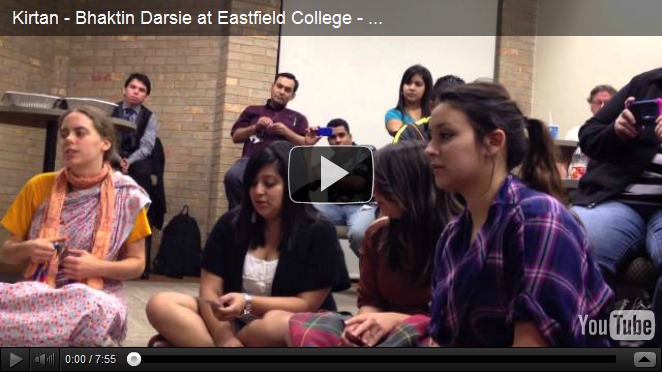
We were invite to a philosophy class at Eastfield to discuss the concise Vedic philosophy. The program ended with a kirtan lead by Bhaktin Darsie and a wonderful feast cooked by Narottamānanda Prabhu.
Tuesday, December 25, 2012
Distributing Santas’ gifts

Book distribution to happy recipients. Distributing Santas' gifts "The devotees of the Supreme Lord, or the persons who are in Kṛṣṇa consciousness, are called santas, and they are always in love with the Lord"-purport to Bhagavad Gita 3.13


Tuesday, December 18, 2012
TEXAS FAITH 90: How would you comfort the families affected by the Connecticut slayings?
Dallas Morning News,
Each week we will post a question to a panel of about two dozen clergy, laity and theologians, all of whom are based in Texas or are from Texas. They will chime in with their responses to the question of the week. And you, readers, will be able to respond to their answers through the comment box.
The slayings today at a Connecticut school obviously present a horribly grim situation. So, drawing upon your faith traditions, how would you try to comfort a family caught up in such an awful scenario?
NITYANANDA CHANDRA DAS, minister of ISKCON (International Society for Krishna Consciousness), Dallas
We share your grief. My wife spent the entire night, off and on, crying. The Bhagavad Gita explains that we can mourn our separation from that person but we should understand that the self is not subject to death.
Bg 2.13 — As the embodied soul continuously passes, in this body, from boyhood to youth to old age, the soul similarly passes into another body at death. A sober person is not bewildered by such a change.
Bg 2.17 — That which pervades the entire body, you should know to be indestructible. No one is able to destroy that imperishable soul.
Bg 2.20 — For the soul there is neither birth nor death at any time. He has not come into being, does not come into being, and will not come into being. He is unborn, eternal, ever-existing and primeval. He is not slain when the body is slain.
Bg 2.22 — As a person puts on new garments, giving up old ones, the soul similarly accepts new material bodies, giving up the old and useless ones.
Bg 2.23 — The soul can never be cut to pieces by any weapon, nor burned by fire, nor moistened by water, nor withered by the wind.
Bg 2.24 — This individual soul is unbreakable and insoluble, and can be neither burned nor dried. He is everlasting, present everywhere, unchangeable, immovable and eternally the same.
Bg 2.25 — It is said that the soul is invisible, inconceivable and immutable. Knowing this, you should not grieve for the body.
Tuesday, December 11, 2012
TEXAS FAITH 89: Is it really possible to heal the world?
Dallas Morning News,
Each week we will post a question to a panel of about two dozen clergy, laity and theologians, all of whom are based in Texas or are from Texas. They will chime in with their responses to the question of the week. And you, readers, will be able to respond to their answers through the comment box.
Rabbi Michael Lerner wrote last week about Chanukah, describing it as “the holiday celebrating the triumph of hope over fear, light over darkness, the powerless over the powerful.”
He went on to say that Chanukah is about “understanding that when we connect with the transformative power of the universe, the Force of Healing and Transformation, YHVH, we become aware that the powerless can become powerful, that oppression of any sort is in contradiction to the fundamental nature of human beings as loving, kind, generous, free, creative, intelligent, attuned to beauty, caring for and needing each other beings created in the image of God. When that energy and awareness permeates our consciousness, no ruling elite and no system of exploitation can possibly last for very long.”
Of course, this also is the month when Christians will hear much about bringing joy to the world, peace on earth and goodwill to all.
But is that so? Is it really possible to heal the world?
Some whose theology predicts an end-times see the world as marching from bad to worse, with God intervening at the end. Others hold to a theology that sees them as being used by God to bring his kingdom on earth as it is in heaven. Still others are neither so fatalistic nor optimistic.
Where do you stand? What does your faith tradition say about healing the world?
NITYANANDA CHANDRA DAS, minister of ISKCON (International Society for Krishna Consciousness), Dallas
This temporary material world serves as an impetus for us souls to give up a false lordship over the temporary. Actually we are not our bodies, we are not black, white, Republican, Democrat, and so on. We are an eternal spirit soul inhabiting a temporary vehicle. This vehicle has four major problems that everyone overlooks: old age, disease, death and then birth again.
In our factual existence there is no death or old age. Therefore, to really have a heavenly life means to have a life free from death. Just as one cannot truly enjoy a meal that you know would be your last, so similarly no soul will find satisfaction in the temporary. 
However, those who are in constant contact with the Supreme find ever new bliss and satisfaction in that relationship. Such bliss in relation to the eternal is ever increasing and can be experienced in this world.
As time goes on, social culture decreases and materialism will increase. That is called Kali Yuga, but this also creates a clearer view that the temporary cannot satisfy.

So as things get worse, a few intelligent or fortunate souls can see the futility of material advancement and thus take shelter of the eternal. Those who take shelter of God will find their hearts gradually become godly and thus they can experience heaven even in hell, what to speak of Earth.
The greatest charity one can do is learning how to love God and teaching others to do so. In this way, one can create a golden age.
