Tuesday, August 30, 2011

From Moses to Mahaprabhu

by Srila Saccidananda Bhaktivinoda Thakura (1838 –1914)

bhaktivinoda.gif - 23543 Bytes

If the reader carefully considers, it will be found that the spiritual science gradually evolved from ancient times and became more simple, more clear and more condensed. The more impurities arising from time and place are removed, the more the beauties of the spiritual science brightly shine before us. This spiritual science took birth in the land of kusha grass on the banks of the Sarasvati river in Brahmavarta. As it gradually gained strength, this spiritual science spent its childhood in the abode of Badarikashram, which is covered with snow. It spent its boyhood in Naimisharanya on the banks of the Gomati river and its youth on the beautiful banks of the Kaveri river in the province of Dravida. The spiritual science attained maturity in Navadvip, on the banks of the Ganges, which purifies the universe.

By studying the history of the world, it is found that the spiritual science reached its peak in Navadvip. The Supreme Absolute Truth is the only object of love for the living entities. Unless one worships Him with attachment, however, the living entity can never attain Him. Even if a person gives up all affection for this world and thinks of the Supreme Lord, He is still not easily achieved. He is controlled and attained by transcendental mellows alone. These mellows are of five types - shanta, dasya, sakya, vatsalya and madhurya.

The first mellow, shanta, is the stage in which the living entity surpasses the pains of material existence and situates himself in transcendence. In that state there is a little happiness, but no feeling of independence. At that time the relationship between the practitioner and the Lord is not yet established.

Dasya rasa is the second mellow. It contains all the ingredients of shanta rasa as well as affection. "The Lord is my master, and I am His eternal servant". This type of relationship is found in dasya rasa. No one cares much for any of the best things of this world unless they are connected with affection. Therefore dasya rasa is superior to shanta rasa in many ways.

Sakya is superior to dasya. In dasya rasa there is a thorn in the form of awe and reverence, but the main ornament in sakya rasa is the feeling of friendship in equality. Among the servants, one who is a friend is superior. There is no doubt about it. In sakya rasa all the wealth of shanta and dasya is included.

It is easy to understand that vatsalya is superior to sakya. A son gives more affection and happiness than any friend. Therefore in vatsalya rasa we find the wealth of four rasas. Although vatsalya rasa is superior to these other rasas, it appears insgnificant before madhurya rasa. There may be many secrets unknown between father and son, but this not the case between husband and wife. Therefore, if we deeply consider, it will be seen that all the above-mentioned rasas attain perfection within madhurya rasa.

If we go through the histories of these five rasas, it is clearly understood that shanta rasa was seen in the beginning days of India. When the soul was not satisfied after performing sacrifices with material ingredients, then transcendentalists like Sanaka, Sanatana, Sanat-kumara, Sananda, Narada and Lord Shiva all became detached from the material world, situated in transcendence and realized shanta rasa.

Much later, dasya rasa manifested in Hanuman, the servant of Sri Ramachandra. That same dasya rasa gradually expanded in the northwest and manifested in a great personality named Moses.

In the age of Dvapara, Uddhava and Arjuna became the qualified authorities of sakhya rasa. They preached this rasa throughout the world. Gradually that rasa expanded up to the Arabian countries and touched the heart of Mohammed, the knower of religious principles.

Vatsalya rasa manifested throughout India in different forms at different times. Among the different forms, vatsalya mixed with opulence crossed India and appeared in a great personality named Jesus Christ, who was a preacher of Jewish religious principles.

Madhurya rasa first shone brightly in Braj. It is extremely rare for this rasa to enter the hearts of conditioned souls, because this rasa tends to remain with qualified, pure living entities. This confidential rasa was preached by Chaitanya Mahaprabhu, the moon of Navadvipa, along with His followers.

Till now, this rasa has not crossed beyond India. Recently a scholar from England named Newman realized something about this rasa and wrote a book about it. The people of Europe and America have not been satisfied with vatsalya rasa mixed with opulence as preached by Jesus Christ. I hope, by the grace of the Lord, in a very short time they will become attached to drinking the intoxicating nectar of madhurya rasa.

It has been seen that any rasa that appears in India eventually spreads to the western countries, therefore madhurya rasa will soon be preached throughout the world. Just as the sun rises first in India and gradually spreads its lights to the West, the matchless splendor of spiritual truth appears first in India and gradually spreads to the Western countries.

Tuesday, August 16, 2011

The Birth of Janmastami, Krishna’s Appearance Festival

Kalachandji

This is an excerpt from the Hari Bhakti Vilasa: Sri Janmastami Vrata Fifteenth Vilasa, Volume Two beginning with text 249

Sri Krishna said: O Yudhishthira, after I had killed the demon Kamsa, Devaki embraced Me, placed Me on her lap, and wept.  When the wrestling was over she stood up in the grandstand. The Kukuras and Andhakas praised her.  Her affectionate kinsmen and their wives surrounded her. Vasudeva came, embraced me, said, "Son! Son!" and wept with a father's love.  His eyes filled with tears, he embraced Balarama and Me. In a choked voice he said, “Today my birth has born fruit. Today my life is lived well. Now I have met my sons, the two glories of the Yadu dynasty.” O king, seeing My parents' happiness, everyone else became happy. Bowing before Me, everyone spoke these words: “Today we are happy. Today Krishna is born. Today the demon Kamsa has fallen in a wrestling match.  O Lord Krishna, please glance at the people in this festival. Please give Your mercy to them and to others also.O Krishna, O Lord who removes all sufferings, please give to us the day when Devaki gave birth to You. We will celebrate a festival in Your honor. O Krishna, please be kind to Your sincere devotees.” Filled with wonder to hear the people speak these words, and the hairs of his body now erect in ecstasy, Vasudeva glanced at Balarama and said:  “It should be so. Please tell the people.”  O son of Pritha, then, on My father's order, I revealed the vow of Janmastami to the people of Mathura. The brahmanas, kshatriyas, vaishyas, shudras, and all others who are pious, from the age of eight years and older, should observe Janmastami. (ekadasi is followed at the same age as well.)  O people, during the monsoon season, on the ashtami of the dark fortnight (krishna-paksha, of the month of Bhadra, when the sun was in Leo and the moon and the star Rohini were both in Taurus, in the middle of the night I was born as the son of Vasudeva and Devaki.  This day will be known in this world as the vow of Janmastami. On this day celebrate a great festival honoring both Me and the goddess. First this festival will be celebrated in Mathura. Later it will become famous in the whole world.  Hearing of this festival, the people began to observe it. May there be peace amongst them. May they be happy. May they have good health.  This festival should be observed every year, for that is pleasing to the Lord. The scriptures also describe some offenses in its observance. 

In the Skanda Purana it is said:

Prahlada and other great kings very faithfully observe the auspicious vow of Janmastami, which is dear to Lord Krishna. Their purpose is to please Lord Vishnu

It was nice noticing Lord Sri Krishna’s prediction that this festival would be celebrated all over the world.  Hare Krishna

Monday, August 8, 2011

Weekend Teachings

As the days get closer and closer to Janmastami our temple and activities become busier and busier.   Last Saturday morning I performed a Nam Karan Yajna, a ceremony by which the newborn baby’s name is decided.   The name chosen was Lalita Devi, the dear friend of Srimati Radharani.   The baby was born during Ekadasi last month right near the Visakha Nakshatra (Visakha is the dear friend of Lalita) and later on found out that her aunty, who is a nice devotee, also has the name Lalita.  Also the beautiful baby looked just like little Lalita in the Little Krishna cartoon.
After finishing that program I went to what I thought would have been another home program.  I was invited a few weeks ago to come and speak at a Bhagavata Saptaha that a Nepali man was organizing.  Much to my surprise there were well over 300 people at this event.  It was held at the Nepali Cultural Center in Dallas.  Entering in the building reminded me of India.  It was about 110 F outside and the building’s AC was struggling.  AC water dripped from the ceiling as the hundreds of Nepalis approached the altar and vyasasana for blessings.  Even with the AC maxed out it was quite hot inside.  There was a big platform and canopy as a vyasasana and I was motioned to sit and speak.  The host asked if I could explain the essence of the Srimad Bhagavatam and its glories.   I spoke at first about so called “material qualities” of the Bhagavatam.  That there is a chapter wherein it is discussed the the smallest calculation of time based on atomic interaction.  Or that there are accurate measurements to the various planets in our solar system, or that you can find accurate descriptions of the growth of the fetus.   Then the discussion let to why the Bhagavatam was produced, the story of Vyasa’s spiritual maturation and finally the goal, Bhakti.   One could see the appreciation that all the Nepali devotees had hearing Bhagavatam Katha.  We followed by inviting them to come to the Janmastami festival.   Later that evening the whole family and I attend a great lecture by His Grace Manonatha Prabhu who led a question and answers session on Veda and Vedanta and spoke about his upcoming Yoga Sutras discourse.  

On Sunday morning we had another very nice program.  I was invited to speak at the Christ United Methodist Church in Plano.  A church with a membership of about 8000.  Murari Vallabh Prabhu, accompanied me on this trip to their beautiful facility.  The building must have had at least 40 class rooms.  We were invited in a room wherein sat fifty 60 year olds.  It was to be a class on Hinduism 101.  We first gave the explanation of the word Hindu and gave a basic Bhagavad Gita 101.   The class was very well received.  Many came to thank us after the class and particularly a gentleman came to me and reading his notes stated, “We are a soul in the vehicle of the body, wow this REALLY puts perspective on things.”  The day was then followed by a wonderful kirtan led by Urjsvat Prabhu at the Sunday Feast. 

Thursday, July 28, 2011

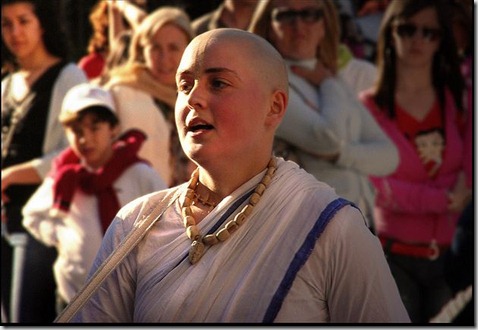
Tulasi Kanthi–neck beads of the Krishna devotees

Tulasi bead
A few weeks ago I posted an article about Tilaka.  In this article Srila Prabhupada was quoted saying,
“I have no objection if members of the Society dress like nice American gentlemen; but in all circumstances a devotee cannot avoid tilaka, flag on head (shikha) and (tulasi) beads on the neck. These are the essential features of a Vaisnava." (SPL to Brahmananda, 14th October, 1967)
Tulsi Kanthi in on this list so I thought that I should also share some info about the kanthi, neckbeads as well. 
The Krishna conscious culture teaches that anyone who is an aspiring devotee of Krishna should wear Tulasi neckbeads for Tulasi is so spiritually potent.   The following are some verses from the Hari Bhakti Vilasa
yah punas tulasī-mālām krtvā kanthe janārdanam |
pūjayet punyam āpnoti pratipuspam gavāyutam ||326||
One who engages in the worship of Śrī Janārdana while wearing tulasī neckbeads accumulates piety equivalent to giving ten thousand cows in charity for each of his flower offerings.
tulasī-kāstha-sambhūtām yo mālām vahate narah |
phalam yacchati daitārih pratyaham dvārakodbhavam ||332||
A person who wears tulasī neckbeads all the time obtains the result of living in Dvārakā.

sadā prītamanās tasya krsna devakī-nandanah |
tulasī-kāstha-sambhūtām yo mālām vahate narah |
prāyaścittam na tasyāsti nāśaucam tasya vigrahe ||334||
tulasī-kāstha-sambhūtām śiraso yasya bhūsanam |
bāhvoh kare ca martyasya dehe tasya sadā harih ||335||
There is no need to perform atonement for a person who wears tulasī neckbeads. Factually, he does not become contaminated at any stage in his life. Śrī Hari resides in the body of a person whose neck and arms are decorated with ornament made of tulasī.
tulasī-kāstha-mālām tu preta-rājasya dūtakāh |
drstvā naśyanti dūrena vātoddhūtam yathā dalam ||337||
tulasī-kāstha-mālābhir bhūsito bhramate yadi |
duhsvapnam durnimittam ca na bhayam śastrajam kvacit ||338||
Just by seeing the tulasī beads on a person’s neck, the Yamadūtas flee to a distant place. A person who wanders here and there after putting on tulasī neckbeads has nothing to fear from an accident, bad dreams, or weapons.
tu_05__00913
Srila Prabhupada also states,
In the Padma Purāna there is a statement describing how a Vaisnava should decorate his body with tilaka and beads: "Persons who put tulasī beads on the neck, who mark twelve places of their bodies as Visnu temples with Visnu's symbolic representations [the four items held in the four hands of Lord Visnu—conch, mace, disc and lotus], and who have visnu-tilaka on their foreheads, are to be understood as the devotees of Lord Visnu in this world. Their presence makes the world purified, and anywhere they remain, they make that place as good as Vaikuntha."
In response to a list of several question asked by disciple Vidya dasi, Srila Prabhupada replies
“1) Tulasi is one devotee who appears wherever there is devotion to Krsna. 2) Tulasis body is spiritual. 3) Yes, jewelry is all right. 4) If possible. 5) Tulasi leaves should be offered to the Deity.
Answers to
1. Is each Tulasi a separate jiva soul or an expansion of one pure devotee?
2. Where does her spirit soul go when she leaves this body?
3. (missing)
4. When tulasi is being cared for by householders in their homes, must two aratis still be offered?
5. When tulasi is being cared for by householders in their homes, may they use her leaves and manjaris on their home offerings or should they take them to the temple?
Srila Prabhupada has also said,
"Just as a pet dog has got a collar, similarly we are pet dogs of God. So we have got this collar. And Yamaraja, the Lord of Death will understand that he-the devotee-is God's dog; he should not be shot down."
Because Tulasi kanthi is so important they are never taken off, but they can be replaced.  Anyone who wears Tulasi neckbeads at the time of death is greatly benefited beyond imagination, therefore it is important to keep them on at all times.   Tulasi also identifies one as a follower of Lord Chaitanya. 
Srila Bhaktivinoda Thakura sings in his Svīkara: Acceptance of Activities Favorable to Pure Devotion - Song 2 Verse 3
gaura-bhakata-priya-veśa dadhānā
tilaka-tulasī-mālā-śobhamānā
3) I will put on the garb that is dear to the devotees of Lord Gaura-sundara, including the twelve Vaisnava tilaka markings on my body and beautiful beads of tulasī wood around my neck.

Srila Bhaktivinoda Thakur also writes in his Jaiva Dharma that of the 64 angas of devotional service the remaining fourty-four are observed to increase one’s bhakti.  Item number one is decoration of the body with the Vaisnava signs of tilaka and tulasī beads.
Q. One may ask that if we are not the body then what is the need of instructions of decoration of the body?
A. Yes we are not the body but unless were are Paramahamsa pure devotees then we are still conditioned by the body.  We don’t want to become falsely transcendental and reject those good things that the greatly intelligent pure devotees has suggested for our spiritual welfare.   Yes, if we are not the body then we also do not need to eat, but because this body is Krishna’s property we take care of it and because this body is Krishna’s property we decorate it in the suggested fashion.  Hare Krishna
Imagem 184

Wednesday, July 27, 2011

TEXAS FAITH 44: What responsibility should Murdoch or any CEO take for their company?


Dallas Morning News,
Each week we will post a question to a panel of about two dozen clergy, laity and theologians, all of whom are based in Texas or are from Texas. They will chime in with their responses to the question of the week. And you, readers, will be able to respond to their answers through the comment box.

Should Rupert Murdoch resign?


That has been one of the top questions swirling around the breathtaking scandal unfolding in Murdoch's media empire in Great Britain. He has apologized for the phone hacking that some of his employees engaged in or knew about. But Murdoch made clear to Parliament last week that he was going nowhere.
That decision upset some critics, who thought he should step down. No doubt some want Murdoch to go because they don't like his journalism, including at Fox News. But others thought it was his responsibility to take the fall.
But is it?


Murdoch contends he didn't know everything everyone below him was doing, which seems plausible. In fact, how does the head of any major company, institution or government agency know what is happening several rungs down? We in the media are often quick to want heads to roll. But why should folks at the top take a fall, if they were not directly involved?


So, here's the discussion for this week:
What does your training as theologians, ethicists, clergy, academics and people of faith teach you about situations like this? Specifically, what responsibility should the leader of an organization take for his or her institution?

NITYANANDA CHANDRA DAS, minister of ISKCON (International Society for Krishna Consciousness), Dallas 
 
The Vedic tradition teaches that if your children are employed and married you should then immediately retire and live a simple life dedicated to increasing your loving attachment and consciousness of Krishna, God.
 

Comments

FormerlyTexasbankerIsStillTwisted

why worship a false god who is a demon in servant hood to Satan, the arch enemy of the one true Living God who gave up His son Jesus, who died for the sins of the world, in order to reconcile mankind to God.

Nityananda Chandra Das

As there is only one Sun. It is not Mexican although known as Sol, or Indian although known as Surya. So similarly there is only one God. Some know Him as Jehovah, some as Jehovah, some as Krishna.

Tuesday, July 26, 2011

The baby grabs the surgeons fingers – Sivaramaswami.com

The baby grabs the surgeons fingers
July 22nd, 2011

An article sent  by Kesava Bharati Maharaja

Read before looking!

Please read before viewing the picture – it’s worth it. A picture began circulating in November. It should be ‘The Picture of the Year,’ or perhaps, ‘Picture of the Decade.’ . The picture is that of a 21-week-old Unborn baby named Samuel Alexander Armas, who is being operated on by surgeon named Joseph Bruner.

The baby was diagnosed with spina bifida and would Not survive if removed from his mother’s womb.

Little Samuel’s mother, Julie Armas, is an obstetrics nurse in Atlanta


She knew of Dr Bruner’s remarkable surgical procedure. Practicing at Vanderbilt Univ Med Ctr in Nashville , he performs these special operations while the baby is still in the womb.

During the procedure, the doctor removes the uterus via C-section and makes a small incision to operate on the baby. As Dr Bruner completed the surgery on Samuel, the little guy reached his tiny, but fully developed hand through the incision and firmly grasped the surgeon’s finger.

Dr Bruner was reported as saying that when his finger was grasped, it was the most emotional moment of his life, and that for an instant during the procedure he was just frozen, totally immobile.

The photograph captures this amazing event with perfect clarity The editors titled the picture, ‘Hand of Hope.’ The text explaining the picture begins, ‘The tiny hand of 21-week-old fetus Samuel Alexander Armas emerges from the mother’s uterus to grasp the finger of Dr Joseph Bruner as if thanking the doctor for the gift of life.’

Little Samuel’s mother said they ‘wept for days’ when they saw the picture. She said, ‘The photo reminds us pregnancy isn’t about disability or an illness, it’s about a little person.’Samuel was born in perfect health, the operation 100 percent successful.

Now see the actual picture.


One Response to “The baby grabs the surgeons fingers”
  1. Gina says:

    July 22, 2011 at 7:47 pm

    Oh wow, that was worth seeing!..Thanks for uploading. What else do they need, for the child to speak? It is so unfortunate, but in Kali it won’t make much difference to those who want to do these acts… just like animal slaughter, the cries of the animals fall on deaf ears..

Sunday, July 10, 2011

Vaishnava Tilak–Marking your body as the temple of God

In the Vaishnava tradition devotees wear the urdhva pundra made of gopi chandan commonly known as tilak. 

"Tilaka means victory personified." (SPL to Tilaka devi dasi,)

By wearing tilak not only does one identify ones body as the temple of the Lord but also one is blessed by the auspicious protection of the Lord.  Not only is the wearer immensely benefited but even those who see the tilak marks are benefited.

“In Kali-yuga one can hardly acquire gold or jeweled ornaments, but the twelve tilaka marks on the body are sufficient as auspicious decorations to purify the body. “  SB 4.12.28 Purport 

Srila Prabhupada emphasized that tilak was part of the essential dress of a devotee. 

“I have no objection if members of the Society dress like nice American gentlemen; but in all circumstances a devotee cannot avoid tilaka, flag on head (shikha) and (tulasi) beads on the neck. These are the essential features of a Vaisnava." (SPL to Brahmananda, 14th October, 1967)

Tilak is applied with the Lord’s holy names thus giving protection to the whole body.

“While decorating the body with tilaka, we give protection to the body by chanting twelve names of Vishnu. Although Govinda, or Lord Vishnu, is one, He has different names and forms with which to act differently.” SB 10.6.27-29 Purport ACBSP

"Persons who are decorated with tilaka or gopī-candana [a kind of clay resembling fuller's earth which is produced in certain quarters of Vrindāvana], and who mark their bodies all over with the holy names of the Lord, and on whose necks and breasts there are tulasī beads, are never approached by the Yamadūtas." The Yamadūtas are the constables of King Yama (the lord of death),  - Nectar Of Devotion Ch. 9

Srila Prabhupada has given the example of a policeman.  He can be identified by his dress.  Downing the dress, the policeman is also reminded that his behavior should honor his position. 

Simply by seeing someone wearing tilak, people are induce to utter the words, “There is a Hare Krishna” and thus they immensely benefit thus we should not see it as something external.

“Just like sometimes on the street some outsider, seeing you, they chant Hare Krsna only by the symbolic, sānketya. Because they see: "They have got tilaka, kunti." Therefore these things are required. Don't become immediately paramahamsa—no tilaka, no kunti and no bead bag. This is not good. Sānketya. So that others may understand, "Here is a Vaisnava. Here is a Krsna devotee..." And if he is simple, he'll chant, "Hare Krsna." This chance should be given. Therefore it is necessary, how people can utter. That chanting may save him from the greatest danger. Therefore it is said, sānketyam pārihāsyam. If somebody jokes... Sometimes they do that. "Hare Krsna" means he is not seriously chanting, but he is trying to joke the other party who is engaged in chanting. And that is also good, pārihāsya.”  - Śrīmad-Bhāgavatam 6.2.13 -- Vṛndāvana, September 15, 1975

Here is a quick video tutorial of how to put on tilak.

Thank you